If you own a home in Okemos, MI, your crawlspace is probably the last place you think about – until something goes wrong. Most homeowners only discover crawlspace problems after noticing soft or bouncy floors, persistent musty smells that no amount of air freshener can fix, or unusually high heating and cooling bills that don’t match their usage habits. By the time these signs appear at the surface level of your home, the damage happening underneath has usually been building for months – sometimes years.
This guide is for Okemos homeowners who have searched “crawlspace repair” and want to understand what’s actually going on down there, what it costs to ignore it, and why mold is almost never absent from the conversation.
Why Okemos Homes Are Particularly Vulnerable
Okemos sits in Ingham County, where clay-heavy soil is common throughout residential neighborhoods. Clay soil is notoriously poor at draining water away from foundations. Instead of allowing rainwater and snowmelt to percolate downward and away from your home, clay holds moisture close to your foundation walls and crawlspace perimeter for extended periods. Combine that with Michigan’s freeze-thaw cycles – where ground expansion and contraction gradually crack foundation walls and shift footings – and you have conditions that almost guarantee moisture infiltration in crawlspaces over time.
Add to that the fact that many Okemos homes were built during the mid-century housing boom with minimal vapor barrier standards, and you begin to understand why crawlspace issues are not a rare exception here – they are a common reality that eventually affects a significant portion of local homeowners.
The Six Most Common Signs Your Crawlspace Needs Repair
Soft, Bouncy, or Uneven Floors Above the Crawlspace If you notice that your hardwood or laminate flooring has developed a slight give underfoot, or if certain spots feel noticeably softer than others, this is often the first surface-level sign of structural damage in the crawlspace below. Wood rot in floor joists or support beams – caused by prolonged moisture exposure – removes the structural rigidity that keeps your floors firm. This is not a cosmetic issue. It is a structural one, and it worsens progressively.
Persistent Musty or Earthy Odors in the Home Crawlspaces are directly connected to your home’s air circulation. Experts estimate that up to 50 percent of the air in your living space on the ground floor comes up from the crawlspace below – a phenomenon known as the stack effect. When mold is actively growing in your crawlspace, those spores and the odors that accompany them are continuously cycling into your living areas. If you’ve tried everything to address a musty smell in your home and nothing works, the source is almost certainly underneath you.
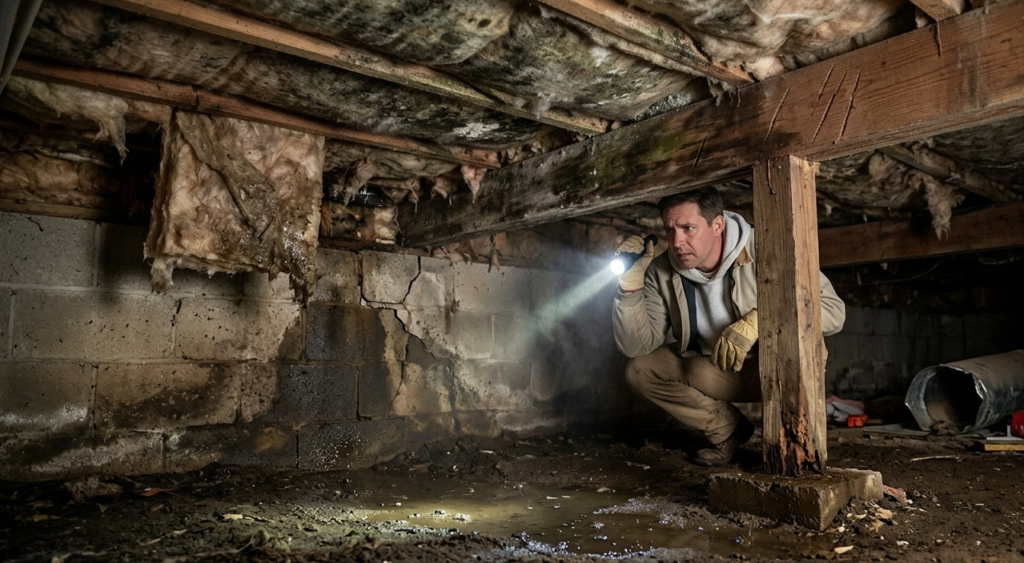
Visible Moisture, Standing Water, or Ice in the Crawlspace Any standing water in a crawlspace is an emergency that demands immediate attention. Even small amounts of pooled water create ideal mold conditions within 24 to 72 hours. Moisture on the walls or floor of the crawlspace that isn’t standing water is still a serious warning sign – it indicates that vapor is either entering from the ground below through an inadequate or failed vapor barrier, or infiltrating through foundation cracks from outside soil.
Increased Allergy Symptoms or Respiratory Issues at Home If family members – particularly children, the elderly, or anyone with asthma – have experienced worsening allergy symptoms, unexplained respiratory irritation, or frequent headaches specifically while at home, mold spores from the crawlspace may be the culprit. Mold species commonly found in Michigan crawlspaces, including Cladosporium, Aspergillus, and Stachybotrys (black mold), all release airborne spores that affect indoor air quality significantly.
Condensation on Pipes, Ductwork, or Insulation If you venture into your crawlspace and notice that pipes, metal ductwork, or insulation materials are covered in condensation, this tells you that the humidity level in the space is high enough to produce moisture on cool surfaces — which means it is also high enough to sustain mold growth on wood, insulation, and other organic materials throughout the space.
Higher Than Normal Energy Bills A crawlspace with compromised insulation, failed vapor barriers, or gaps in the foundation envelope allows unconditioned outside air to enter your home’s thermal boundary. In Michigan winters, this forces your heating system to work significantly harder. If your utility bills have crept upward without a clear explanation, a compromised crawlspace could be the reason, and repairs would likely pay for themselves in energy savings over time.
The Connection Between Crawlspace Repair and Mold – Why You Can’t Address One Without the Other
This is the most important thing to understand if you are researching crawlspace repair in Okemos: structural repair and mold remediation are not competing services. They are sequential steps in fixing the same problem.
Here is what typically happens in a crawlspace that has been neglected over several Michigan winters. Moisture enters – through the soil, through foundation cracks, or through condensation from humid summer air. That moisture saturates the wooden floor joists, support beams, and any remaining vapor barrier material. Wood that stays wet long enough begins to rot, losing structural integrity. And in that same wet, dark, poorly ventilated environment, mold begins to colonize the wood, insulation, and soil – often before the structural rot becomes noticeable.
By the time a homeowner notices soft floors or a musty smell, they are usually looking at a crawlspace that needs both structural repair work and professional mold remediation. Doing only one without the other guarantees that the problem returns. If you repair the structural damage but leave active mold colonies in place, the spores continue to circulate through your home and the organic material in the crawlspace continues to degrade. If you remediate the mold but don’t address the moisture entry points and structural damage, new mold growth begins within weeks of the remediation being completed.
This is exactly why our crawlspace mold remediation service in Lansing and Okemos is built around addressing the source conditions – not just the visible symptoms. You can read more about our full process on our Crawlspace Mold Remediation service page, which covers everything from initial moisture testing and mold identification through vapor barrier installation, antimicrobial treatment, and post-remediation verification.
What Crawlspace Repair in Okemos Typically Involves
While every crawlspace is different, a comprehensive repair process for an Okemos home typically covers several areas working together.
Vapor barrier repair or full replacement is almost always part of the process. Most older homes have thin, degraded plastic sheeting that has torn, shifted, or simply degraded beyond effectiveness. Modern encapsulation systems use heavy-duty reinforced barriers that cover the floor and often the walls of the crawlspace, dramatically reducing ground moisture intrusion.
Foundation crack sealing addresses the specific entry points through which outside groundwater and soil moisture are entering the space. In Okemos, clay soil expansion during wet seasons creates lateral pressure on foundation walls that over time produces hairline cracks – and those cracks, small as they appear, allow consistent moisture infiltration.
Joist and beam assessment identifies any wood structural members that have been compromised by rot. Depending on severity, affected members may be sistered – meaning a new structural member is fastened alongside the damaged one – or replaced entirely. This is the work that directly addresses the soft floor symptoms homeowners notice upstairs.
Drainage correction and sump system evaluation ensures that water is being directed away from the crawlspace effectively. In some Okemos properties, grading issues or failed interior drainage systems allow water to pool near or inside the crawlspace perimeter, and correcting this is fundamental to long-term success.
Insulation assessment determines whether the crawlspace insulation has been compromised by moisture. Wet insulation loses its thermal value entirely and becomes a prime surface for mold growth – in many cases, it needs to be removed, the underlying surfaces treated, and new insulation installed once the space is dry and protected.
The Risk of Waiting
Crawlspace problems in Michigan do not resolve on their own. They follow a predictable progression. Moisture enters, wood deteriorates, mold grows, air quality declines, structural integrity weakens, and repair costs increase. A crawlspace issue that costs a few thousand dollars to address in its early stages can escalate to a full remediation and structural repair project costing significantly more if left unaddressed through even one or two additional Michigan winters.
There is also the health dimension. Mold in a crawlspace is not contained to the crawlspace. As described above, the stack effect pulls crawlspace air continuously into your living spaces, and prolonged mold spore exposure at home is a recognized contributor to chronic respiratory problems, particularly in children and older adults.
Leave a Reply